"THE TWO SISTERS"
America probably could not have won its freedom from the British during the American Revolution without the help of the French. France provided arms, ships, money and men to the American colonies. Some Frenchmen - most notably the Marquis de Lafayette, a close friend of George Washington - even became high-ranking officers in the American army. It was an alliance of respect and friendship that the French would not forget.
Almost 100 years later, in 1865, after the end of the American Civil War, several French intellectuals, who were opposed to the oppressive regime of Napoleon III, were at a small dinner party. They discussed their admiration for America's success in establishing a democratic government and abolishing slavery at the end of the civil war. The dinner was hosted by Edouard Rene Lefebvre de Laboulaye. Laboulaye was a scholar, jurist, abolitionist and a leader of the "liberals," the political group dedicated to establishing a French republican government.
During the evening, talk turned to the close historic ties and love of liberty the two nations shared. Laboulaye noted that there was "a genuine flow of sympathy" between the two nations and he called France and America, "the two sisters."
As he continued speaking, reflecting on the centennial of American independence only 11 years in the future, Laboulaye commented, "Wouldn't it be wonderful if people in France gave the United States a great monument as a lasting memorial to independence and thereby showed that the French government was also dedicated to the idea of human liberty?"
Laboulaye's question struck a responsive chord in one of his guests, Frédéric-Auguste Bartholdi, a successful, 31-year-old sculptor from Colmar, a town in the eastern province of Alsace, France.
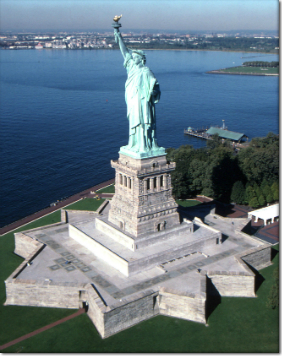
Years later, recalling the dinner, Bartholdi wrote that Laboulaye's idea "interested me so deeply that it remained fixed in my memory." So was sown the seed of inspiration that would become the Statue of Liberty.
Frédéric-Auguste Bartholdi
The sculptor who designed the Statue of Liberty, Frédéric-Auguste Bartholdi, was born into a well-to-do family in Colmar, France on August 2, 1834.
Bartholdi's father, a civil servant and prosperous landowner, died when the child was only two years old, so he was raised by his stern, possessive mother, Charlotte.
Bartholdi began his career as a painter, but it was as a sculptor that he was to express his true spirit and gain his greatest fame. His first commission for a public monument came to him at the young age of 18. It was for a statue of one of Colmar's native sons, General Jean Rapp, a leader of Napoléon Bonaparte's army. Even at 18, Bartholdi loved bigness. The statue of the general was 12 feet tall and was created in Bartholdi's studio, where the ceiling was only one inch higher. The statue established his reputation as a sculptor of note and led to many commissions for similar, oversized, patriotic works.
A man of his time, Bartholdi wasn't alone in his passion for art on a grand scale. During the 19th century, large-scale public monuments were an especially popular art form. It was an age of ostentation, largely inspired by classical Greek and Roman civilizations. Most monuments reflected either the dress or architecture of these ancient times, so the artistic style of the 19th century came to be known as "neoclassical." The Statue of Liberty would be patterned after the goddess, Libertas, the Roman personification of freedom.
But it was a trip to Egypt that shifted Bartholdi's artistic perspective from simply grand to colossal. The overwhelming size and mysterious majesty of the Pyramids and the Sphinx were awesome to the enthusiastic young Bartholdi. He wrote, "Their kindly and impassive glance seems to ignore the present and to be fixed upon an unlimited future."
In 1870, with the beginning of the Franco-Prussian War, Bartholdi served as a major in the French army in his hometown of Colmar. When the Germans annexed the entire Alsace region, making its residents German citizens, the reality of the word "liberty" took on a new, personal meaning for Bartholdi.
In time, France's Third Republic, would emerge out of the ruins of the Franco-Prussian War. Meanwhile, partially as propaganda to advance the cause of those who were seeking the creation of a French Republic, Laboulaye suggested that Bartholdi should travel to America.
In recalling his conversation with Laboulaye several years later, Bartholdi wrote: "'Go to see that country,' said he [Laboulaye] to me. 'Propose to our friends over there to make with us a monument, a common work, in remembrance of the ancient friendship of France and the United States. If ... you find a plan that will excite public enthusiasm, we are convinced that it will be successful on both continents, and we will do a work that will have far-reaching moral effect.'"
Bartholdi responded, "I will try to glorify the Republic and Liberty over there, in the hope that someday I will find it again here."
So Bartholdi was now to become a salesman. Armed with letters of introduction from Laboulaye to some of America's most influential men, Bartholdi sailed to New York in 1871.