I have a HUGE nicely shaped cedar on the outskirts of my yard. There is a large seemingly good gardening area in front of it. Prefer not to cut the cedar, as it's beautiful. I've heard that cedars could be bad to plant around. How bad? Plants still grow, but slightly less? a lot less? just don't bear fruit? die? Does it depend on the type plants? (The grass and weeds sure don't seem inhibited by it. ) How far away from it should I plant or what can I plant that won't be affected? Some choices I'm interested in: vegetables, strawberries, black or raspberries, blueberries, muscadines, hazelnut bushes, dwarf fruit trees, or if nothing else, flowers. Also, there's a medium sized pecan tree near another prospective gardening spot. Any problems with planting near that? I know black walnuts are supposed to cause problems. But now that I think of it, my mother's 57 yr. old veg. garden is fairly close to a black walnut tree, and she raised a family of five off that garden with few trips to the grocery store. So what are the rules?


Navigation
Install the app
How to install the app on iOS
Follow along with the video below to see how to install our site as a web app on your home screen.
Note: This feature may not be available in some browsers.
More options
You are using an out of date browser. It may not display this or other websites correctly.
You should upgrade or use an alternative browser.
You should upgrade or use an alternative browser.
How badly will cedar tree affect what I plant near it?
- Thread starter elf
- Start date

Ridgerunner
Garden Master
- Joined
- Mar 20, 2009
- Messages
- 8,246
- Reaction score
- 10,132
- Points
- 397
- Location
- Southeast Louisiana Zone 9A
This is one of the clearer articles I've seen on the problems and possibilities around black walnuts. The way I understand it, hickories and pecans also produce the juglone, but not in the amounts that black walnuts do. I have not seen any specific warnings about them. Another thing to watch for. My grafted English Walnut is grafted onto a black walnut root stock. That means anything in the root zone of that tree is at risk.
http://ohioline.osu.edu/hyg-fact/1000/1148.html
But that is the black walnut and you are interested in the cedar. Other than the regular problems around trees, such as the roots sucking moisture from the ground and the shade, the only specific problem I am aware of with cedar trees is cedar apple rust. I think that is specific to apples and other trees and vegetables are not affected, but I'm not 100% sure. Some apple varieties are supposed to be resistant, but I personally would be cautious about them. Resistant does not necessarily mean immune. Other than apples, I'm not aware of any specific restrictions around cedars. Maybe their needles turn th soil acidic when they decompose?
http://ohioline.osu.edu/hyg-fact/1000/1148.html
But that is the black walnut and you are interested in the cedar. Other than the regular problems around trees, such as the roots sucking moisture from the ground and the shade, the only specific problem I am aware of with cedar trees is cedar apple rust. I think that is specific to apples and other trees and vegetables are not affected, but I'm not 100% sure. Some apple varieties are supposed to be resistant, but I personally would be cautious about them. Resistant does not necessarily mean immune. Other than apples, I'm not aware of any specific restrictions around cedars. Maybe their needles turn th soil acidic when they decompose?

hoodat
Garden Addicted
Correct me if I'm wrong but I presume you are speaking of red cedar since it is the commonest tree called cedar in the US. If so cedar is alelopeceous, a fancy word meaning it secretes a chemical that inhibits growth of other vegetation around it. It isn't as strong as some other species, such as the black walnut already mentioned but it will slow or dwarf anything close to it. With extra care and fertilizer it is possible to overcome this. Most of the effect will be within a few feet of the drip line.elf said:I have a HUGE nicely shaped cedar on the outskirts of my yard. There is a large seemingly good gardening area in front of it. Prefer not to cut the cedar, as it's beautiful. I've heard that cedars could be bad to plant around. How bad? Plants still grow, but slightly less? a lot less? just don't bear fruit? die? Does it depend on the type plants? (The grass and weeds sure don't seem inhibited by it. ) How far away from it should I plant or what can I plant that won't be affected? Some choices I'm interested in: vegetables, strawberries, black or raspberries, blueberries, muscadines, hazelnut bushes, dwarf fruit trees, or if nothing else, flowers. Also, there's a medium sized pecan tree near another prospective gardening spot. Any problems with planting near that? I know black walnuts are supposed to cause problems. But now that I think of it, my mother's 57 yr. old veg. garden is fairly close to a black walnut tree, and she raised a family of five off that garden with few trips to the grocery store. So what are the rules?

lesa
Garden Master
I have an old planting of a cedar tree in my front garden. I tore everything else out, but I couldn't cut that one down, since the robins always nest in it! I don't have veggies in there, but I have tons of perennials, etc. and have never noticed an ill effect. As Hoodat points out, the roots are sometimes in my way, but I work around that. If that is the area you have to garden- I say give it a try. One of the most beautiful gardens I have ever seen, was surrounded by black walnuts....so,go for it.

digitS'
Garden Master
I don't know the rules . . . but will just give a few "impressions" is all. Lesa obviously has some experience and it looks positive.
You haven't told us what type of cedar this is. It wouldn't make too much difference to me but what are known as cedars in North America come in both Thuja this-or-that or Juniperus. My limited experience is with the Thuja occidentalis that are often planted in yards and with Thuja plicata, the Western Red Cedar that grows here in our forests.
Just as a observation, I've seen the Western Red Cedar brought down from their cool, wet, often north-facing locations in the mountains and planted in yards. Thirty years later, they are still there growing in the full sun! What I think may be happening is that this cedar is "forced" to live where it does naturally because other trees out-compete it elsewhere! That suggests the opposite of what you are wondering about. The tree, even tho' it often grows in dense cedar thickets and may have some hemlock and other evergreens about, cannot handle too much competition from other plants. . . . maybe .
.
We might think of cedar as having some allelopathic properties like the black walnut because its needles, bark and wood are so fragrant. This may not be so. After all, cedar bark is a common mulch. It may suppress weeds (usually with landscape cloth under it) but I've never heard that the bark interferes with the growth of the ornamentals that it protects from weeds.
My limited experience with growing other plants around living cedars has to do with Thuja occidentalis, or what I usually call arborvitae. There was a row of them in my backyard at another home and the neighbor has had a row on the other side of the fence from my cutting garden.
They do suck a lot of moisture out of the ground. I had to provide sufficient soil moisture to grow the green beans I used to plant beside the arborvitae in my backyard.
They compete with the annual flowers I plant near the neighbor's fence but aren't very successful living in his yard. I can't blame their problems on a single person - there have been a series of renters in that house since the owner turned it over to a management agency, or whatever.
Since running the automatic sprinkler in the backyard made life difficult for his 3 pitbulls, one renter turned off the sprinkler system over 2 summers. The willow and arborvitae began to die.
Things haven't improved with the new neighbor and his 2 pitbulls. To be sure, the willow died and blew down just before he moved in. It crashed into a metal shed which was unfortunate for the arborvitae because a few of them must have relied on the rain runoff from that shed for water. They are the only 5 or 6 arborvitae left alive out of about 15 that once lived on the other side of that fence. Life was tuff for them last year, they may not make it thru 2010.
My guess is that if you take good care of your cedar, Elf, you may be able to grow lots of things around it. Soil moisture would probably be your greatest concern AFTER you have figured out where things can get some sun.
Pecans? North Carolina State says they "also produce juglone, but in smaller amounts compared to black walnut." NSCU lists several other common landscape trees on that page that you may want to look at.
Combined with the plants listed on that Ohio State webpage that Ridgerunner provides, I wonder whether we really need to worry much about the allelopathy of even the black walnut, if we just do a little planning on what-goes-where.
I hope this helps.
Steve
You haven't told us what type of cedar this is. It wouldn't make too much difference to me but what are known as cedars in North America come in both Thuja this-or-that or Juniperus. My limited experience is with the Thuja occidentalis that are often planted in yards and with Thuja plicata, the Western Red Cedar that grows here in our forests.
Just as a observation, I've seen the Western Red Cedar brought down from their cool, wet, often north-facing locations in the mountains and planted in yards. Thirty years later, they are still there growing in the full sun! What I think may be happening is that this cedar is "forced" to live where it does naturally because other trees out-compete it elsewhere! That suggests the opposite of what you are wondering about. The tree, even tho' it often grows in dense cedar thickets and may have some hemlock and other evergreens about, cannot handle too much competition from other plants. . . . maybe
.We might think of cedar as having some allelopathic properties like the black walnut because its needles, bark and wood are so fragrant. This may not be so. After all, cedar bark is a common mulch. It may suppress weeds (usually with landscape cloth under it) but I've never heard that the bark interferes with the growth of the ornamentals that it protects from weeds.
My limited experience with growing other plants around living cedars has to do with Thuja occidentalis, or what I usually call arborvitae. There was a row of them in my backyard at another home and the neighbor has had a row on the other side of the fence from my cutting garden.
They do suck a lot of moisture out of the ground. I had to provide sufficient soil moisture to grow the green beans I used to plant beside the arborvitae in my backyard.
They compete with the annual flowers I plant near the neighbor's fence but aren't very successful living in his yard. I can't blame their problems on a single person - there have been a series of renters in that house since the owner turned it over to a management agency, or whatever.
Since running the automatic sprinkler in the backyard made life difficult for his 3 pitbulls, one renter turned off the sprinkler system over 2 summers. The willow and arborvitae began to die.
Things haven't improved with the new neighbor and his 2 pitbulls. To be sure, the willow died and blew down just before he moved in. It crashed into a metal shed which was unfortunate for the arborvitae because a few of them must have relied on the rain runoff from that shed for water. They are the only 5 or 6 arborvitae left alive out of about 15 that once lived on the other side of that fence. Life was tuff for them last year, they may not make it thru 2010.
My guess is that if you take good care of your cedar, Elf, you may be able to grow lots of things around it. Soil moisture would probably be your greatest concern AFTER you have figured out where things can get some sun.
Pecans? North Carolina State says they "also produce juglone, but in smaller amounts compared to black walnut." NSCU lists several other common landscape trees on that page that you may want to look at.
Combined with the plants listed on that Ohio State webpage that Ridgerunner provides, I wonder whether we really need to worry much about the allelopathy of even the black walnut, if we just do a little planning on what-goes-where.
I hope this helps.
Steve
patandchickens
Deeply Rooted
IME, both for white cedar (Thuja) and red cedar (Juniperus), once you get beyond the area that gets a lot of leaf (well, needle) fall, it does not seem to affect plants much. That's maybe, what, 10' radius from a really BIG OLD tree, or less for smaller ones.
You don't want to dig or till too close to the roots of the cedar, though, since being evergreens they are extra sensitive to loss of roots. So in terms of digging/tilling I'd suggest giving 'em a bit wider berth even than you would in regards whatcha can plant there. Unless you don't much care what happens to the tree.
JME, good luck, have fun,
Pat
You don't want to dig or till too close to the roots of the cedar, though, since being evergreens they are extra sensitive to loss of roots. So in terms of digging/tilling I'd suggest giving 'em a bit wider berth even than you would in regards whatcha can plant there. Unless you don't much care what happens to the tree.
JME, good luck, have fun,
Pat
- Thread starter
- #7
Thanks, guys! This is just a common red cedar like the ones that seed up all over our Ga. woods. Nice big Christmas tree shape in big area of full sun, but soil holds moisture well. Sounds like the cedar may not be too detrimental. I'll just experiment with some extra veggies and temp. fence as planned. That is, whenever I get time to mow again and till.Went over area with my DR brushcutter twice and it needs it again. Believe me, cedars don't inhibit poison ivy or wild blackberry. By the way, if you've ever considered the DR, it's a worthy investment. I bought an abused ghosttown of a little farm, and the poor DR has had to eat a lot of rotten fence wire and tin shards that appear to grow out of the ground along with the glass and nails someone planted. Nothing stops it! I'll be sending more questions your way, I'm sure. Glad I found this site.
patandchickens
Deeply Rooted
I would love to have a DR brushcutter, but I will give the same glowing testimonial to the DR wheeled string trimmer. I sweated and swore and constantly repaired a Craftsman model for six years before I got brave (and disgusted) enough to shell out for the DR version... and OH MY GOSH it is WONDERFUL. Well designed, the BEST instruction manual I have ever seen (seriously!), it works beautifully and does not spindle grass around itself or jam (unless you do soemthing really stupid with it), and no repairs yet. Big fan!elf said:By the way, if you've ever considered the DR, it's a worthy investment. I bought an abused ghosttown of a little farm, and the poor DR has had to eat a lot of rotten fence wire and tin shards that appear to grow out of the ground along with the glass and nails someone planted.

Pat

journey11
Garden Master
My sister has perennial flowers planted around her red cedar. They don't seem affected at all...they look great. Where the shade is cast would be the main thing to consider, I would think. Also, with apple trees you will definitely need to select varieties that are resistant to cedar apple rust. Freedom, MacFree, Jonafree and Liberty are a few I know of.

jojo54
Garden Ornament
We have a cedar hedge around most of the front yard. It has been here many years as opposed to me being here < 2years. There was a flower bed in front of part of the hedge that had gone to weed and I have been recleiming it. Plants and bulbs are doing fine. The lawn goes up to the rest of the hedge and it does great as well. I think one big factor is enough water for the plants and the cedars. It was very dry last summer and many peoples' cedars did not survive because of lack of watering. Luckily, we have our own well so ours are doing nicely.
Here are some pics of the hedge. Tulips are finished and now much else blooming yet.
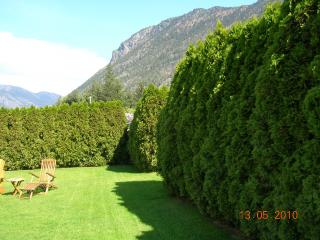
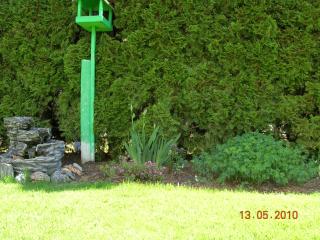
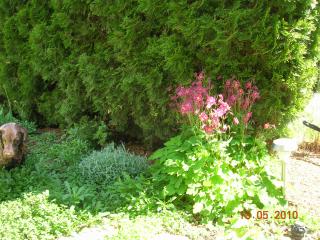
Here are some pics of the hedge. Tulips are finished and now much else blooming yet.


