Don't count me out yet, digitS! True, my house is pretty much what I put into it. (I suspect our old Yankee screw-driver is buried somewhere in the walls.) I still find a thing or two when I prowl around the 30 acres. However, our current project is redoing our son's new house. . . circa 1832. Together we already redid the kitchen with new wiring, plumbing, insulation, flooring and cupboards that fit the age and style of the Victorian/Scandinavian? structure. Now we are tearing the den walls and ceiling out to the studs/rafters to redo.
Anyone know how this guy 'insulated' his outside walls in 1832? Something else we've never seen. There is wood lathe and plaster throughout the house, but on the outside walls there is another layer of wood lathe and plaster. . . outside wall, air space, wood lathe and rough plaster, air space, then wood lathe and plaster finish. Not in the least fun to remove it, but it probably did work better than nothing in the walls at all.
DS had a visit from a grandchild of someone who used to live in the house and we have found that his beautiful wood trim is made from tupelo trees. Never heard of that wood being used for trim around here. It grows quite a bit to the south of Wisconsin so the Judge who built the house would have had to have it shipped in from down south. We're being VERY careful removing the wood work since I doubt we could get it replaced.
So far, we've found old pennies and old newspapers, but there's a lot of exploration on all three floors to be done before we finish. Could it be that they milled the trim wood right on site? There was an old saw set-up in the basement with a huge saw blade. Unfortunately, the orchard, gardens, and carriage house that belonged to the original owner had been divided off and sold as a building site well before we got the place.



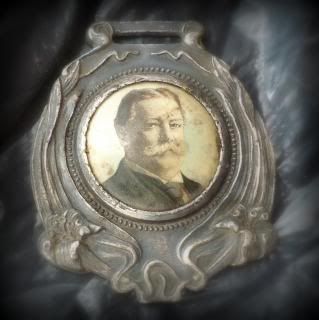
 . I asked a local antique guy about it and he said that these campaign pins are commonly counterfeited but the fact that it isn't in the most pristine shape and missing its ribbon suggests that it is the real thing. Taft ran for president 8 years after this house was built.


