what is really interesting to me about the “Fagioli di Sarconi” beans is that many of the patterns have shown up in my own growouts here when i've never sourced any of those beans before.
I think that all bean varieties contain a large variety of genes. It just depends on what crosses with what variety and what genes finally wind up making pairs which shows up in the seed coat colors and patterns you get. Colors and patterns are very repeatable.
When I first discovered the outcrossed bean I now have that is stable and was named Angel Eye. I thought I had a pattern on that bean that might be totally unique. Until I ran across an Australian website recently called Seed Freaks. It's a website by a fellow named Bob Reid and his private bean collection. If you go down to the 12th row of beans and the second photo from the left is a bean called Kelly Lake and the pattern at the eye looks very much like Angel Eye except the seed shape is not the same. So what I am getting at is seed coats are repeatable and it all depends on what genes make the pairs that display the color and pattern on your bean. I'm not surprised that patterns or colors that have shown up in your bean crosses are either identical or very similar to the patterns and colors on the Sarconi beans. I've had the Jacob's Cattle pattern and color show up a number of times in my own crosses on different shaped seeds and I haven't grown Jacob's Cattle in at least 12 years.
What is interesting is the name Kelly Lake is a name Robert Lobitz used to name one of his beans. I had one time purchased a Kelly Lake bean from another seed dealer in Australia and it was totally different. Two more photos to the right of this bean is another Robert Lobitz name called Koronis Pinto that I didn't even know existed.
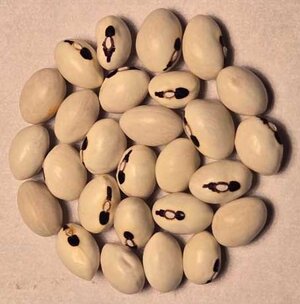
Nasieddu - Pole Dry. From Valpiano, Italy. Now we have discovered that Nasieddu translates as "Little Nose". The beans origin is likely the upper Val d’Agri valley in Basilicata, southern Italy along with all the other Nasieddu beans shown previously. About half of my seed of this bean didn't germinate in 2025. So I wound up with only three plants. It was still a poor showing with just enough seed to fill a 3 x 4 inch (8 x 10 cm) ziploc baggie. Maybe I will try this bean again in another season and location.
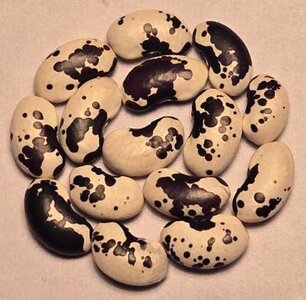
New Mexico Black & White Appaloosa - Pole Dry. I was keeping this bean in my freezer as Appaloosa Black And White. I've seen it on a number of sites and named as New Mexico Black And White Appaloosa. Similar to the red one of similar pattern and history being found in a cave in the south west dating to over a thousand years ago. This bean was very productive in 2025 with 6 plants producing over 2 pounds of beans (992 g).
Nasieddu - Pole Dry........................................New Mexico Black And White Appaloosa - Pole Dry
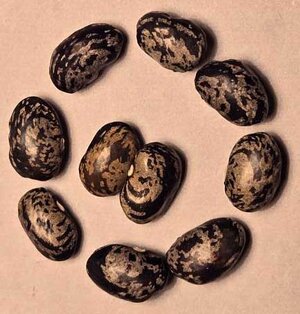
Night Sky - Pole Dry. From a Canadain grower who got it from a friend. All the best seed I could pick out of it's seed crop is in the photo. It will be grown again in 2026. I like this beans appearnce. I think it's a very handsome bean. Fairly large seed as well.
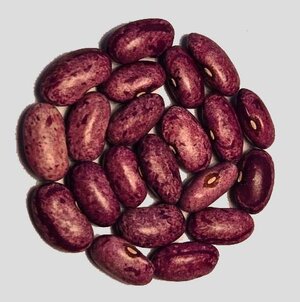
Ntingi - Pole Dry. I planted a very light pink frosted looking Ntingi and got this dark red one. I will try the original Ntingi again in 2026. Seed production of this bean in 2025 was also very poor.
Night Sky - Pole Dry............................................Ntingi - Pole Dry
PGI stands for Protected Geographical Indication. It's awarded when a crop or product has a strong link to a particular area. For plant‑based products, this means the crop must meet strict regional standards (e.g., traditional growing methods, minimum quality, and traceable provenance) tied to that geographical area. For example the name Tarbais bean should only be used if it is grown in the region of Tarbes in SW France