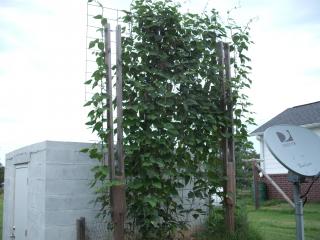
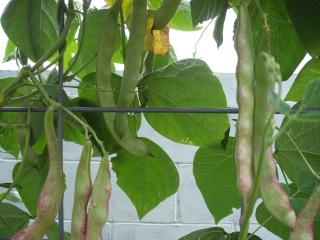
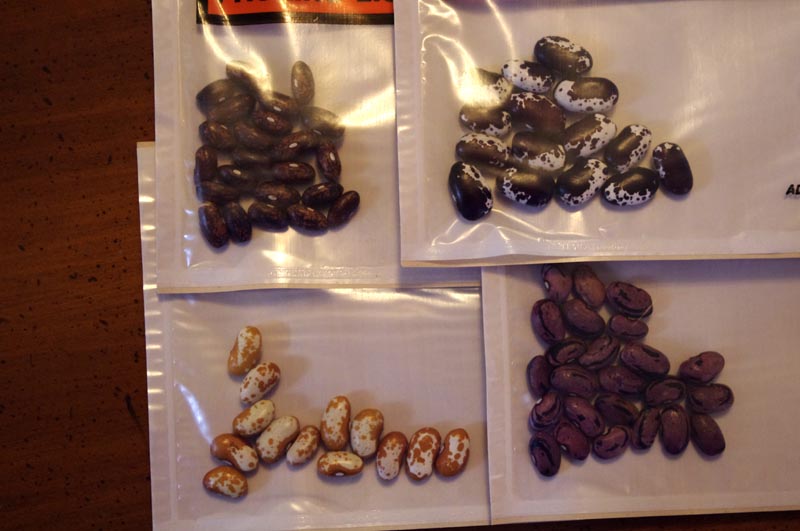
Oh, Journey, you got Vermont Appaloosa too? Can I see a closeup photo of yours? No matter how bone dry my pods are when I pick them, my Appaloosa beans are about half white and half deep blue. I kind of think they have to cure for several months before the brown starts to develop. Some varieties are like that.
I have some Sicilian heirloom beans with a name I can never remember quite right, Fagiola di Polizia Blanda, which means THE BLONDE BEANS OF POLIZIA. These are a 2 tone pole bean that are half white and half soft beige. When first picked, no matter how bone dry the pod, they are almost pure white, with the beige part barely showing color at all. In fact, when I first grew them last year and was harvesting them, I was thinking I must have a very poor selection growing. Then, early this year while I was going through my beans to decide which ones to plant, I looked at them and VOYLA! They had colored up! (Polizia is a town in Sicily. Apparently they have near that town an historical garden park where they grow these beans along with another set of several varieties that are a closely guarded set of local heirlooms that are not allowed out. I understand there is also a darker colored variety that has not yet escaped from there, lol.) Italy has some amazing beans!
Most seed catalogs seem to divide beans into a few categories:
SNAP BUSH
SNAP POLE
DRY
And maybe a few other categories:
WAX
MISC
While I see so many categories are out there!
DRY COMMERCIAL BUSH
DRY VINEY BUSH
DRY POLE
DRY ITALIAN BUSH
DRY ITALIAN POLE
DRY EAST EUROPEAN BUSH
DRY EAST EUROPEAN POLE
DRY NATIVE AMERICAN BUSH
DRY NATIVE AMERICAN VINEY
DRY NATIVE AMERICAN POLE
DRY MEXICAN BUSH
DRY MEXICAN COMMERCIAL BUSH
DRY MEXICAN VINEY
DRY MEXICAN POLE
Oh shoot, just making the categories can be a long list! I'm just going by memory and half a cup of coffee. But shoot, Borlotti, Annelino, Bolitas, Frijoles, Cranberry, Horticultural, and then there are inbetweens and boths!
Sometimes I imagine it is almost as if each bean is its own category. Not quite of course. I was reading about a breeding program for Kidney beans by the state of Michigan that began around 1908. The breeders were really fine tuning the varieties for high production by weight and by volume. Fine tuning for producing large crops even if the plants got disease, that is, resistance to disease. For different diseases, especially some "halo" disease. It looks like Kidney beans have gotten the most government support for breeding programs. And sure enough, those seem to be the plants that have those commercial qualities.
Russ' DAPPLE GREY plants have that commercial quality of growth! They are not at all Kidney beans. (Finished that first cup of coffee...) Dapple Grey plants are just beautiful! Mid season, not early. A few pods have ripened for a sample, but most of the pods are still down in there, slowly developing. I actually think there may be a set of "slow development to ripen" genes that some beans have. Petaluma Gold Rush has it too I think. For the most part I like it, but it does mean the pods are in the garden for a longer time, vulnerable to bugs or vermin.
I'm just babbling now...