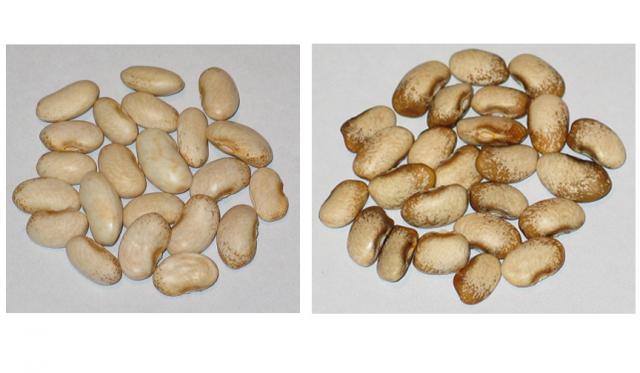
Im a lot more familiar with chicken genetics than bean genetics but Id think genetics are genetics. The principles should be the same. You start with the parent generation, two different breeds or varieties. Call these P1 if you have to call them something different than Mommy and Daddy. Since beans are perfect seeds and generally self-pollinate without the use of pollinating insects, this is the only generation you need to actually do a cross. Its different with chickens.
The first hybrid cross is F1. Half the genes come from the P1 Mommy and half from the P1 Daddy. If Mommy and Daddy are pure in their breeding, then all the F1 hybrids should look and grow alike. Since the bean P1 Mommys genetics determine what her seed looks like, yeah, the F1 seeds should look like the Mommy. You wont know if there was a cross or not by looking at them. With chickens, you can tell the difference in the chicks, but not by looking at the egg they hatched from. The analogy is the egg they hatched from and the bean they grew from looks like what the purebreed Mommy produces.
The F2s is when it gets really messy. Which gene in that gene pair is passed down is given randomly from either hybrid parent. The F2 generation is the one with the most genetic variety. Those genes can go together in a lot of different ways. Genetically this should be the generation that has the most genetic diversity. But that doesnt mean you can see it. With chickens you can see the differences when the chicken hatches, but with beans you have to plant the seeds and get a harvest to see what is going on.
The F3s is when you start to knock out genetic diversity. When you select an F2 seed to plant, you eliminate the varying genetics in the beans you choose to not plant. You will still have a lot of recessives hiding under dominants that you have to sort out, but each succeeding generation will get more pure genetically until you have something that finally reproduces true. I dont know how many generations that takes with beans since they are perfect flowers and self-pollinate. With chickens that depends on the skill of the person selecting which rooster to breed with which hen. Some of that depends on how much genetic difference there was in the P1 Mommy and P1 Daddy to start with.
The genetic diversity is in the seeds. The visible results are in the harvest of those seeds. Based on this the beans you get when you plant the F1 hybrid seeds should exhibit the most genetic diversity when you harvest them. Marshall, youre good at genetics. Does this make sense?
Russ, it may be the later part of the month before I send them because of a birthday trip then a wedding trip, but I have some Jeminez drying for you. Those three plants I grew produced a lot.
Addendum:
Lets go with two genes, a and b. Purebreed P1 Mommy will have am, am and bm,bm. Purebreed P1 Daddy will have ad,ad and bd,bd. Hybrid F1 will have am,ad and bm,bd, one gene from each parent.
F2 might have:
am,am and bm,bm
am,ad and bm,bm
ad,ad and bm,bm
am,am and bm,bd
am,ad and bm,bd
ad,ad and bm,bd
am,am and bd,bd
am,ad and bd,bd
ad,ad and bd,bd
What these look like will depend on dominants and recessives. You could do Punnett squares to see what the odds of these combinations are.
Now select which of these you want to plant. Ill select:
am,am and bm,bd.
F3 will get:
am,bm and
am,bd. ad is forever eliminated.
There are a whole lot more genes involved than just two, but this should demonstrate the principle.