We have been having torrential rains here. I got about three quarters of my pole beans planted and a few days later had such a hard fast rain that the sprouting beans washed away. I was out after the rain squelching through the mud trying to find the seeds. I identified the ones I could and replanted them and planted the rest in pots labeled with a seed description and the words "who knows"! If it quits raining I have seeds to replant several of the kinds. I do have a couple seeds of the ones I got from this network and hopefully can get them to sprout.


Navigation
Install the app
How to install the app on iOS
Follow along with the video below to see how to install our site as a web app on your home screen.
Note: This feature may not be available in some browsers.
More options
You are using an out of date browser. It may not display this or other websites correctly.
You should upgrade or use an alternative browser.
You should upgrade or use an alternative browser.
2015 Little Easy Bean Network - Old Beans Should Never Die !
- Thread starter Blue-Jay
- Start date
- Thread starter
- #262

Blue-Jay
Garden Master
- Joined
- Jan 12, 2013
- Messages
- 3,640
- Reaction score
- 11,803
- Points
- 333
- Location
- Woodstock, Illinois Zone 5
Hi @NancyJ10x,
There has been so much drought around the country in the last few years that now some areas are experiencing just the opposite extreme. I guess this is just another one of the challenges of gardening.
There has been so much drought around the country in the last few years that now some areas are experiencing just the opposite extreme. I guess this is just another one of the challenges of gardening.

buckabucka
Garden Addicted
I am not officially participating in the bean network this year, but I am trying some new varieties that I received from @marshallsmyth .
I am late getting my garden in this year, -very busy, but yesterday and today I put in:
Buxton Buckshot
Hanna Hank
By God
Blue Satin
Sallee Dunahoo
And five experimental beans that also came from an assortment Marshall sent. I just numbered those beans, and took a photo of each bean next to the corresponding number, so I'll be able to see if they breed true or create something altogether different.
I have an outcross from True Red Cranberry that I'm trying too. It will be fun to see what grows this year.
I am late getting my garden in this year, -very busy, but yesterday and today I put in:
Buxton Buckshot
Hanna Hank
By God
Blue Satin
Sallee Dunahoo
And five experimental beans that also came from an assortment Marshall sent. I just numbered those beans, and took a photo of each bean next to the corresponding number, so I'll be able to see if they breed true or create something altogether different.
I have an outcross from True Red Cranberry that I'm trying too. It will be fun to see what grows this year.

teamneu
Chillin' In The Garden
@flowerweaver
Actually, it was the Leakey Death Ride put on by the Fort Worth Bicycling Association. A three day event from Bandera to Leakey, a hundred mile loop out of Leakey (the best part, of course) and back to Bandera. I slowly got out of shape after my 16 yo dd was born. Sometimes I really miss it.
But now I get my nature fix gardening, and it can require stamina and preseverance almost as much as riding.
P.S. Before I get back on topic, have you seen hill country scenic art by Greg Glowka? I have some of his amazingly beautiful prints in my living room.
Actually, it was the Leakey Death Ride put on by the Fort Worth Bicycling Association. A three day event from Bandera to Leakey, a hundred mile loop out of Leakey (the best part, of course) and back to Bandera. I slowly got out of shape after my 16 yo dd was born. Sometimes I really miss it.
But now I get my nature fix gardening, and it can require stamina and preseverance almost as much as riding.
P.S. Before I get back on topic, have you seen hill country scenic art by Greg Glowka? I have some of his amazingly beautiful prints in my living room.

flowerweaver
Deeply Rooted
@teamnue Yes, I am familiar with that ride, I always had to schedule mine around it. Your ride took you right by my place.
Thanks for introducing me to the art of Greg Glowka, it's very evocative of the places I see around me. I am also an artist but I mostly do still lifes with birds.
Thanks for introducing me to the art of Greg Glowka, it's very evocative of the places I see around me. I am also an artist but I mostly do still lifes with birds.
- Thread starter
- #266
Blue-Jay
Garden Master
- Joined
- Jan 12, 2013
- Messages
- 3,640
- Reaction score
- 11,803
- Points
- 333
- Location
- Woodstock, Illinois Zone 5
Last Thursday was a slightly longer day than the day before planting my massive bean field. I left the house and 8:30 am and got an early start at 9 am planting. Finished up a little after 7 pm. By the time I had all my tool picked up and packed in my van it was almost 7:30. Planted 11 rows on Wednesday and the second day planted the remaining 16 rows. Thursday night I was just to beat to post anything here. Friday and Saturday I worked around my house doing things. Sunday I felt tired all day and did very little. So Thursday's planting when like this below.
1. Golden Pond (a segregation of Goose Cranberry outcross that was shown on the Bean Fahsion Show in the autumn of 2014). 2. Southern Soldier (acquired this from SSE this winter. It looks almost like a black eyed soldier). 3. Kishwaukee Yellow (one of my early outcrossed beans from the late 1970's). 4. Kenearly 5.Boston Favorite (a horticultural bean I had grown before in the early 80's) 6. Sex Without Strings (a wax bean I think Marshall sent to me). 7. Billingsgagte Segregation #3 (this was pictured in the 2014 Bean Fashion Show). 8. African Premier Segregation #5 (this was pictured in the 2014 Bean Fashion Show). 9. Gold Beauty (another Robert Lobitz bean that I have not yet grown before). 10. Jacob's Cattle 11. An Unnamed Outcross from Will Bonsall 12. Paula Snap (another Robert Lobitz bean I have never grown before). 13. Purple Diamond (a purple podded bush bean of Robert Lobitz). 14. Pebblestone Buff (this was pictured in the 2014 Bean Fashion show and it's only a working name for now). 15. Early Shellout Bunch (a horticultural bean I had grown before in the early 80's). 16. Billingsgate Segregation #4 (pictured in the 2014 Bean Fashion Show). 17. An Unnamed Outcross from Will Bonsall 18. Brown Trout (a bean patterned like Jacob's Cattle but in brown and white). 19. Rabbit's Foot Segregation #3 (pictured in the 2014 Bean Fashion Show) 20. Pandora (a black and white outcross from Pawnee that was pictured in the 2014 Bean Fashion Show). 21. Idelight (this was a bean bred by a University of Idaho plant breeder and released to the public in 1951, and re-released in 2014 to celebrate the U of I's 125th anniversary). 22. Boston Beauty (obtained this from SSE this past winter to see if their verbal description of the seed was how the bean would actually look when I got it. Didn't look anything like I thought it would). 23. Edagava Fulanaki (an elongated seed that has maroon red across the hilum half of the seed. The red runs the entire length of the seed and the bottom half is white. Sent to me by Joseph Simcox. A variety he collected in Bulgaria). 24. Preston's Old Fashioned Family Heirloom (you remember this one from last year when SeedO grew it out and he sent back a nice quanity of lovely looking seed). 25. Purple Stardust (a Robert Lobitz dry bean that has a coloration similar to Mrociumere but heavier seed). 26. Shortwave Sunshine (an outcross I found in the snap bean Junin in 2013 and pictured in the 2014 Bean Fashion Show). 27. Sweetwater (another pretty outcross I found last summer and pictured in the 2014 Bean Fashion Show). 28. Rabbits Foot Segregation #4 (pictured in the 2014 Bean Fashion Show). 29. Unnamed Outcross from Will Bonsall 30. Unnamed Outcross from Will Bonsall 31. Wanamingo Segregation (pictured in the 2014 Bean Fashion show and now has a working name of Marengo. @flowerweaver's husband will probably be able to relate to this name). 32. Pandora (a second planting of this bean) 33. Billingsgate Segregation #5 (pictured in the 2014 Bean Fashion Show). 34. Kishwaukee Green (A green podded companion of Kishwaukee Yellow developed in a planting of KY back in the 1980's, and it also had the same seed coat as KY and also threw off a black seed coat and a tan buff seed coat just the same as KY would do. After I had dropped out of gardening and SSE for a number of years and re-started my bean collecting again in 2011. I couldn't find Kishwaukee Green. I thought well nobody grew it and kept it alive. This winter a fellow in Maine finds my website because he wants to identify a bean he got from a truck garden farmer that had been growing this green snap bean for quite awhile that he had worked for and he too had then grew this bean for the last 12 years. He emails me and says I think I got a bean you would like to have. He says I'm very sure I got your Kishwaukee Green. So he traded me some seed for something he picked off my website, and when the seeds arrived sure enough they look exactly like KY. Same seedcoat, same size and shape, and the two other seed coat colors that it would also produce. I'll see how the plants match up with KY this summer. They should look the same, and I have a feeling they probably will. 35. Black Trout 36. Fowler (a brown seeded snap bean I grew last summer that the Japanese beetles don't feed on). 37. Cherry Trout (another of my original outcrossed beans from the early 80's). 38. Goose Cranberry Cross (pictured in the 2014 Bean Fashion Show). 39. Unnamed Outcross from Will Bonsall 40. Nagfzuraz (a horticultural bean I got in trade this past winter). 41. Pebblestone Purple (a purple segregation of the Pebbldstone patterned bean pictured in the 2014 Bean Fashion Show). 42. Unnamed Outcross from Will Bonsall 43. Nippersink Segregation #1 (pictured in the 2014 Bean Fashion Show). 44. Kishwaukee Yellow (another planting Of KY). 45. Rabbits Foot Segregation #5 (pictured in the 2014 Bean Fashion Show). 46. Wonmdermere Segregation (picture in the 2014 Bean Fashion Show). 47. Unnamed Outcross from Will Bonsall 48. Unnamed Outcross from Will Bonsall 49. Theresa's Pink Portugal (@aftermidnight I'm growing your pink Kidney bean this season). 50. Heilings 51. Flagolet Pleurs (a green seeded French bean; that Joseph Simcox sent to me in 2013). 52. Prince Purple (a Robert Lobitz dry bean that I've never grown before). 53. Billingsgate Segregation #6 (pictured in the 2014 Bean Fashion Show). 54. Unnamed Outcross from Will Bonsall 55. Mottled bean found in 2014's growout of Pebblestone 56. Purple Prince. (got this bean from a bean collector in Germany about 2 years ago. 57. Rabbit's Foot Segregation #6 (pictured in the 2014 Bean Fashion Show). 58. Purple Dove (another Robert Lobitz bean I have not yet grown). 59. Unnamed Outcross from Will Bonsall 60. Staley's Surprise (a historical snap variety from Australia developed by an Australian seedsman Aurthur Staley. The variety has been around over a hundred years. Sent to me by Hal). 61. Striped Thrush Segregation (might have pictured this in the 2014 Bean Fashion Show). 62. Unnamed
outcross from Will Bonsall 63. Nippersink Segregation #2 64. Unnamed Outcross from Will Bonsall 65.Unnamed Outcross from Will Bonsall 66. Rabbits Foot 67. Rabbits Foot Segregation #7). 68. Idaho Refugee 69. White Lion (segregation of a Goose Cranberry outcross that was pictured but unnamed at the time of the 2014 Bean Fashion Show). 70. Unnamed Outcross from Will Bonsall 71. Billingsgate Segregation #7. 72. Goose Cranberry Segregation #2 (pictured in the 2014 Bean Fashion Show). 73. Purple Rain (a purpled podded Robert Lobitz variety I have never grown). 74. Black Eyed Gem Segregation #3 (pictured in the 2014 Bean Fashion Show). 75. Nippersink Segregation #4 (pictured in the 2014 Bean Fashion Show). 76. White Amish (A working name for now. Maybe permanent, you just never know. Found this white bean with a little spot of yellow color on either side of the eye growing among a bean called Jacob's Cattle Amish in 2014). 77. Black Eyed Gem 78. Spring Valley Purple (another of the Robert Lobitz legacy of beans). 79. 97-B (I got a hold of about 18 outcrossed beans that Robert Lobitz would have grown out if he had not passed away when he did. He gave them number codes before he gave them names. The codes are meaningless to me, as I don't know what the logic for the codes were, but as I grow them out I will keep track of them each season by their code numbers for now). 80. AA 81. 97A-00B 82. Packet #30A, 97D-00M-03A 83. Packet #34D, 97-98A-02 84. No Code 85. Packet # 30B, 97D-00M-03A 86. Packet #34C, 97-98A-02 87. 00A 88. A-98D 89. 93-DS-44 90. Packet #10 Brown Round Seeded 91. Packet #10 White Round Seeded 92. Packet #34, 97-98A-02 93. 00A-03D 94. Packet #10 Black Round Seeded 95. B Contender X Trout 96. 01-03.
Oh ! More Ibuprofen. The planting is finished. LOL.
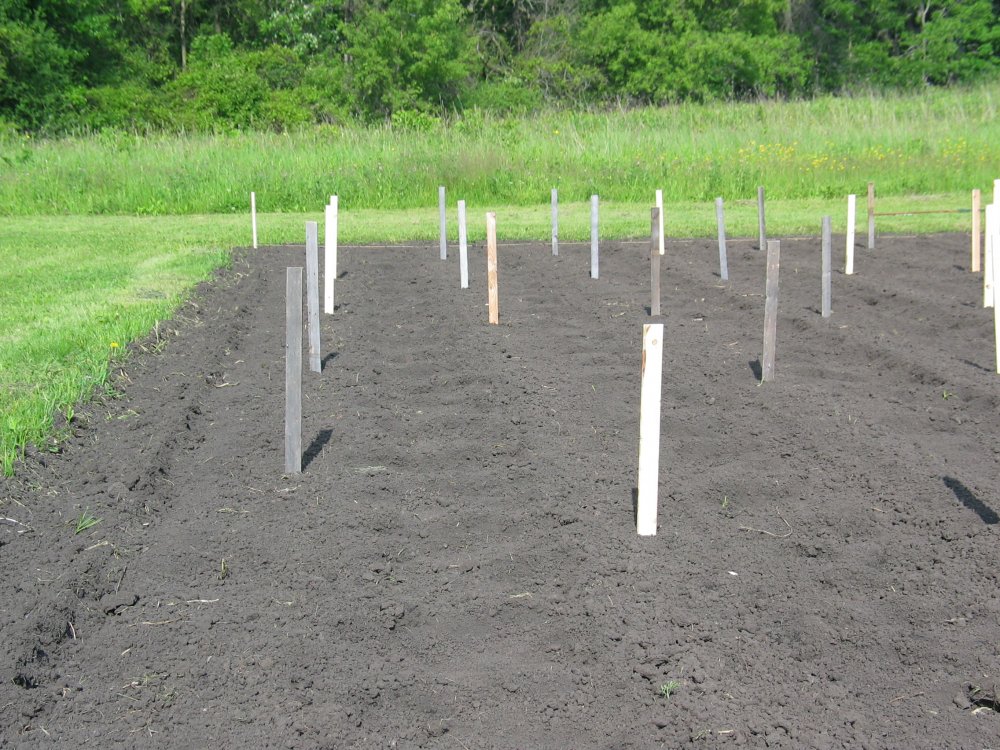
In years past I would plant a row of beans with maybe as many as 8 varieties in a row with beans that had seed coats different enough from each other that they were easy to sort them out, and harvested all those varieties in a row together and keep their pods in the correct corresponding row box. At shelling time, and I hand shell almost all of them. Last year I had noticed one time when I was shelling a box that had pods from only one variety. I saw how much faster it was to shell them since I didn't have to look for the pile that a particular bean was being sorted to. So this year I am still planting different looking beans in the same row together but seperated by stakes in the ground so when I harvest dry pods. Each variety will be harvested seperately and their dry pods will be kept in their own seperate box until shelling time. I'm sure this will speed shelling time tremendously. Finding new segregations and outcrossed seeds will be much easier to peg to which variety the seed mother is. Actually, it wasn't hard in the past, but I spent time going down the row at harvest time cracking open pods to find new seed coats and then take the time to make a note of it. Now I can just harvest pods and discover the segregations and outcrosses at shelling time. After that the Bean Fashion Show.
1. Golden Pond (a segregation of Goose Cranberry outcross that was shown on the Bean Fahsion Show in the autumn of 2014). 2. Southern Soldier (acquired this from SSE this winter. It looks almost like a black eyed soldier). 3. Kishwaukee Yellow (one of my early outcrossed beans from the late 1970's). 4. Kenearly 5.Boston Favorite (a horticultural bean I had grown before in the early 80's) 6. Sex Without Strings (a wax bean I think Marshall sent to me). 7. Billingsgagte Segregation #3 (this was pictured in the 2014 Bean Fashion Show). 8. African Premier Segregation #5 (this was pictured in the 2014 Bean Fashion Show). 9. Gold Beauty (another Robert Lobitz bean that I have not yet grown before). 10. Jacob's Cattle 11. An Unnamed Outcross from Will Bonsall 12. Paula Snap (another Robert Lobitz bean I have never grown before). 13. Purple Diamond (a purple podded bush bean of Robert Lobitz). 14. Pebblestone Buff (this was pictured in the 2014 Bean Fashion show and it's only a working name for now). 15. Early Shellout Bunch (a horticultural bean I had grown before in the early 80's). 16. Billingsgate Segregation #4 (pictured in the 2014 Bean Fashion Show). 17. An Unnamed Outcross from Will Bonsall 18. Brown Trout (a bean patterned like Jacob's Cattle but in brown and white). 19. Rabbit's Foot Segregation #3 (pictured in the 2014 Bean Fashion Show) 20. Pandora (a black and white outcross from Pawnee that was pictured in the 2014 Bean Fashion Show). 21. Idelight (this was a bean bred by a University of Idaho plant breeder and released to the public in 1951, and re-released in 2014 to celebrate the U of I's 125th anniversary). 22. Boston Beauty (obtained this from SSE this past winter to see if their verbal description of the seed was how the bean would actually look when I got it. Didn't look anything like I thought it would). 23. Edagava Fulanaki (an elongated seed that has maroon red across the hilum half of the seed. The red runs the entire length of the seed and the bottom half is white. Sent to me by Joseph Simcox. A variety he collected in Bulgaria). 24. Preston's Old Fashioned Family Heirloom (you remember this one from last year when SeedO grew it out and he sent back a nice quanity of lovely looking seed). 25. Purple Stardust (a Robert Lobitz dry bean that has a coloration similar to Mrociumere but heavier seed). 26. Shortwave Sunshine (an outcross I found in the snap bean Junin in 2013 and pictured in the 2014 Bean Fashion Show). 27. Sweetwater (another pretty outcross I found last summer and pictured in the 2014 Bean Fashion Show). 28. Rabbits Foot Segregation #4 (pictured in the 2014 Bean Fashion Show). 29. Unnamed Outcross from Will Bonsall 30. Unnamed Outcross from Will Bonsall 31. Wanamingo Segregation (pictured in the 2014 Bean Fashion show and now has a working name of Marengo. @flowerweaver's husband will probably be able to relate to this name). 32. Pandora (a second planting of this bean) 33. Billingsgate Segregation #5 (pictured in the 2014 Bean Fashion Show). 34. Kishwaukee Green (A green podded companion of Kishwaukee Yellow developed in a planting of KY back in the 1980's, and it also had the same seed coat as KY and also threw off a black seed coat and a tan buff seed coat just the same as KY would do. After I had dropped out of gardening and SSE for a number of years and re-started my bean collecting again in 2011. I couldn't find Kishwaukee Green. I thought well nobody grew it and kept it alive. This winter a fellow in Maine finds my website because he wants to identify a bean he got from a truck garden farmer that had been growing this green snap bean for quite awhile that he had worked for and he too had then grew this bean for the last 12 years. He emails me and says I think I got a bean you would like to have. He says I'm very sure I got your Kishwaukee Green. So he traded me some seed for something he picked off my website, and when the seeds arrived sure enough they look exactly like KY. Same seedcoat, same size and shape, and the two other seed coat colors that it would also produce. I'll see how the plants match up with KY this summer. They should look the same, and I have a feeling they probably will. 35. Black Trout 36. Fowler (a brown seeded snap bean I grew last summer that the Japanese beetles don't feed on). 37. Cherry Trout (another of my original outcrossed beans from the early 80's). 38. Goose Cranberry Cross (pictured in the 2014 Bean Fashion Show). 39. Unnamed Outcross from Will Bonsall 40. Nagfzuraz (a horticultural bean I got in trade this past winter). 41. Pebblestone Purple (a purple segregation of the Pebbldstone patterned bean pictured in the 2014 Bean Fashion Show). 42. Unnamed Outcross from Will Bonsall 43. Nippersink Segregation #1 (pictured in the 2014 Bean Fashion Show). 44. Kishwaukee Yellow (another planting Of KY). 45. Rabbits Foot Segregation #5 (pictured in the 2014 Bean Fashion Show). 46. Wonmdermere Segregation (picture in the 2014 Bean Fashion Show). 47. Unnamed Outcross from Will Bonsall 48. Unnamed Outcross from Will Bonsall 49. Theresa's Pink Portugal (@aftermidnight I'm growing your pink Kidney bean this season). 50. Heilings 51. Flagolet Pleurs (a green seeded French bean; that Joseph Simcox sent to me in 2013). 52. Prince Purple (a Robert Lobitz dry bean that I've never grown before). 53. Billingsgate Segregation #6 (pictured in the 2014 Bean Fashion Show). 54. Unnamed Outcross from Will Bonsall 55. Mottled bean found in 2014's growout of Pebblestone 56. Purple Prince. (got this bean from a bean collector in Germany about 2 years ago. 57. Rabbit's Foot Segregation #6 (pictured in the 2014 Bean Fashion Show). 58. Purple Dove (another Robert Lobitz bean I have not yet grown). 59. Unnamed Outcross from Will Bonsall 60. Staley's Surprise (a historical snap variety from Australia developed by an Australian seedsman Aurthur Staley. The variety has been around over a hundred years. Sent to me by Hal). 61. Striped Thrush Segregation (might have pictured this in the 2014 Bean Fashion Show). 62. Unnamed
outcross from Will Bonsall 63. Nippersink Segregation #2 64. Unnamed Outcross from Will Bonsall 65.Unnamed Outcross from Will Bonsall 66. Rabbits Foot 67. Rabbits Foot Segregation #7). 68. Idaho Refugee 69. White Lion (segregation of a Goose Cranberry outcross that was pictured but unnamed at the time of the 2014 Bean Fashion Show). 70. Unnamed Outcross from Will Bonsall 71. Billingsgate Segregation #7. 72. Goose Cranberry Segregation #2 (pictured in the 2014 Bean Fashion Show). 73. Purple Rain (a purpled podded Robert Lobitz variety I have never grown). 74. Black Eyed Gem Segregation #3 (pictured in the 2014 Bean Fashion Show). 75. Nippersink Segregation #4 (pictured in the 2014 Bean Fashion Show). 76. White Amish (A working name for now. Maybe permanent, you just never know. Found this white bean with a little spot of yellow color on either side of the eye growing among a bean called Jacob's Cattle Amish in 2014). 77. Black Eyed Gem 78. Spring Valley Purple (another of the Robert Lobitz legacy of beans). 79. 97-B (I got a hold of about 18 outcrossed beans that Robert Lobitz would have grown out if he had not passed away when he did. He gave them number codes before he gave them names. The codes are meaningless to me, as I don't know what the logic for the codes were, but as I grow them out I will keep track of them each season by their code numbers for now). 80. AA 81. 97A-00B 82. Packet #30A, 97D-00M-03A 83. Packet #34D, 97-98A-02 84. No Code 85. Packet # 30B, 97D-00M-03A 86. Packet #34C, 97-98A-02 87. 00A 88. A-98D 89. 93-DS-44 90. Packet #10 Brown Round Seeded 91. Packet #10 White Round Seeded 92. Packet #34, 97-98A-02 93. 00A-03D 94. Packet #10 Black Round Seeded 95. B Contender X Trout 96. 01-03.
Oh ! More Ibuprofen. The planting is finished. LOL.
In years past I would plant a row of beans with maybe as many as 8 varieties in a row with beans that had seed coats different enough from each other that they were easy to sort them out, and harvested all those varieties in a row together and keep their pods in the correct corresponding row box. At shelling time, and I hand shell almost all of them. Last year I had noticed one time when I was shelling a box that had pods from only one variety. I saw how much faster it was to shell them since I didn't have to look for the pile that a particular bean was being sorted to. So this year I am still planting different looking beans in the same row together but seperated by stakes in the ground so when I harvest dry pods. Each variety will be harvested seperately and their dry pods will be kept in their own seperate box until shelling time. I'm sure this will speed shelling time tremendously. Finding new segregations and outcrossed seeds will be much easier to peg to which variety the seed mother is. Actually, it wasn't hard in the past, but I spent time going down the row at harvest time cracking open pods to find new seed coats and then take the time to make a note of it. Now I can just harvest pods and discover the segregations and outcrosses at shelling time. After that the Bean Fashion Show.
flowerweaver
Deeply Rooted
That's what I do @Bluejay77 . I've found that planting what I have alphabetically by bean form that usually the seed coats are quite different, and when they are not I swap a few out. I recycle grocery bags and write each name on with a sharpie, and harvest accordingly. In previous years I had the same sorting piles and decided it was too much work. This also helps me to know from where any segregations are coming.

Chickie'sMomaInNH
Garden Master
i do a similar method with the stakes for my garlic varieties. i have the names of each type written with sharpie marker. i think i should take and dip the tops in a bright paint for next season and then re-write the names on them. that way it isn't too hard to see the writing. without them painted the wood turns gray and the writing is hard to see.
flowerweaver
Deeply Rooted
Yup, @Bluejay77 he knows exactly where Merengo is located!  Wish my soil looked like yours!
Wish my soil looked like yours!
teamneu
Chillin' In The Garden
@Bluejay77, what is the 2014 Bean Fashion show?
Thanks
Thanks
- Thread starter
- #270
Blue-Jay
Garden Master
- Joined
- Jan 12, 2013
- Messages
- 3,640
- Reaction score
- 11,803
- Points
- 333
- Location
- Woodstock, Illinois Zone 5
The Bean Fashion Show is when anyone of us wants to take pictures of all the beans we grew this season and put up photos of them on this thread. I put up photos of any new outcrosses I find for the season and also photos of what the past seasons segregations produced in the current season.
You can look at last years bean fashion show by going to The 2014 Little Easy Bean Network which you will find on page 4 of this thread list, and then go to about page 85 for the start of last years Bean Fashion Show and contiue to progress through more of the pages. You will get the idea by reading the posts and looking at all the photos. Last year Baymule said it was more fun than watching TV.
You can look at last years bean fashion show by going to The 2014 Little Easy Bean Network which you will find on page 4 of this thread list, and then go to about page 85 for the start of last years Bean Fashion Show and contiue to progress through more of the pages. You will get the idea by reading the posts and looking at all the photos. Last year Baymule said it was more fun than watching TV.
Latest posts
-
-

-
 Picture Of The Week (POW) Information & Submissions
- Latest: Shades-of-Oregon


