@Bluejay77 this is a tremendous honor and memory from:
Some of you have been to our past Campouts and were lucky enough to meet Jeff McCormack and Patty Wallens. They’re both very special people, wise and intuitive. Jeff has been on Seed Savers’ Board of Directors for several years now. Last Christmas Jeff and Patty sent my family a little book...

cerestrust.org
[
"
Some of you have been to our past Campouts and were lucky enough to meet Jeff McCormack and Patty Wallens. They’re both very special people, wise and intuitive. Jeff has been on Seed Savers’ Board of Directors for several years now. Last Christmas Jeff and Patty sent my family a little book called Caretakers of Wonder. It is a wonderful children’s book that was written by Cooper Edens, who also did its beautiful illustrations. It’s even available through our local bookstore, so I imagine you could find it in bookstores across the country. The book makes a wonderful gift, especially for families with small children. Let me read you parts of it, because I know some of you will enjoy it as much as my family does.
“This very night, while you lie quietly in your bed, open your eyes. Now, look out your window! For even at this yawning hour, so many of your friends are working to keep the world magical. Yes, they are the ones who make new stars and put them up… The ones who keep the moon company, feeding him when he’s too thin and watching his diet when he’s too full. The ones who keep the sky and the horizon tightly fastened to each other… They are the ones weaving the meadows and telling the trees where to stand. The ones putting fruit back on the branches. The ones painting feathers on birds and designs on the wings of butterflies. The ones practicing the great rainbow balancing act. The ones collecting yesterday’s raindrops, mending old clouds, and delivering newly stuffed ones… They are the ones who will raise the sun into place. The ones who will load up the night and bring it back to storage. The ones who will give the wind directions, fly the clouds, and tell the rain where to fall… Now, while you sleep tonight… imagine what you most would like to do to help keep the world magical? For you know that one of these nights your friends are going to tap on your window and invite you to become one of the Caretakers of Wonder.”
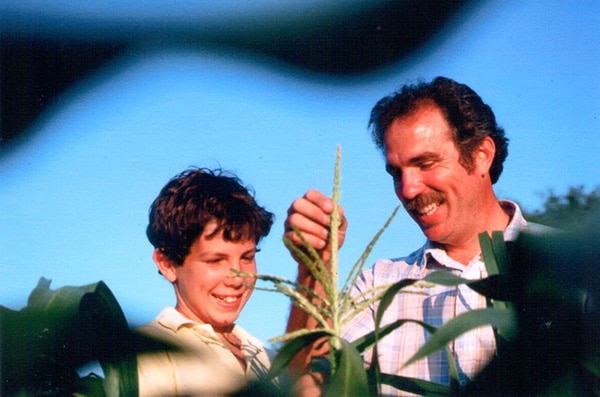
My kids really love this little book, and so do I. A decade ago when Seed Savers was really starting to take shape, one of the things I hoped for was the chance to garden full-time. That seems rather ironic now, because almost all of my time is spent in an office sitting at a computer terminal. During the day I am seldom in the gardens at Heritage Farm. But I walk in the gardens almost every evening, usually at dusk. Dusk is a very special time of day, a time when we see much more clearly, so I often walk at dusk in the gardens. One evening last week, my seven-year-old daughter Carrie and I were walking in the gardens, hand in hand. We were walking up and down the rows, marveling at the incredible beauty and diversity. The chill that flows through the valley each evening had just brushed past us. I told Carrie that our family was very lucky being able to live at Heritage Farm surrounded by this beauty, and that many of these unique varieties were probably being grown only in our gardens. Carrie smiled up at me with her big brown eyes sparkling and exclaimed, “We really are caretakers of wonder.”
Since then I have been thinking a lot about all of us being caretakers of wonder, if you will. I’ve also been thinking about the child-like wonder that we are all born with, but seem to lose somewhere along the way. As we grow older, our thought processes change and become more developed. We become increasingly immersed in thought and gradually lose the ability to feel with our hearts. The loss of those deep feelings also diminishes our ability to dream about the way things could be; what were once vitally important dreams often just shrivel. Deep inside every one of us, however, that sense of child-like wonder still exists. But now it takes some very special situations to touch it, to bring it back out. Each of us still experiences that sense of wonder when we see the beauty of a delicate wildflower, when we walk among apple trees in full fruit, when we see a squash blossom early in the morning sparkling with dew, when we watch a hawk circling and hear it scream, or when we stand deep in a pine woods just listening and feeling.
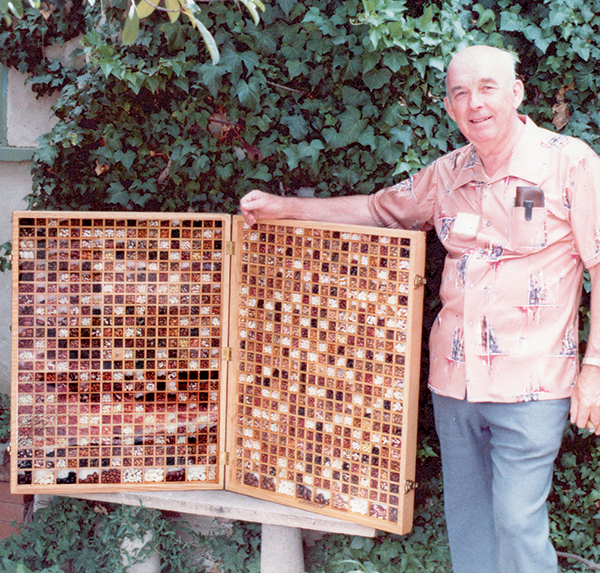
These moments of wonder touch all of us at certain times. I have tried to think back to the moments that have touched me deeply during the last ten years. Some of those moments would include trips that I made to visit a few of Seed Savers’ larger collectors early on. By 1981 I had been working with Seed Savers Exchange for half a dozen years already. The network had grown to the point that some of our folks were putting together fairly good collections of more than 300 varieties, which at that time we thought were huge. One trip took me near Chicago to meet Russ Crow, and then on over into Michigan to meet Ralph Stevenson. Russ and Ralph were both bean collectors. That same summer I also traveled to western Minnesota to meet a potato collector named Robert Lobitz. Each time that I met one of these fellows, we ended up walking in their gardens at dusk. Those gardens were the first times that I had ever seen the diversity available to gardeners in this country. Those were the first times that I really saw our garden heritage.
I remember walking in Russ Crow’s garden and being blown away by all of those beans… (laughter)… Oh, come on now. We weren’t eating them. We were just looking at the plants… (laughter)… There were about 300 different varieties of beans in that one garden. I had never seen anything like it and was absolutely amazed at the diversity. The leaves were all different sizes and had different shapes. The plants ranged in size from the smallest dwarfs to vigorous giants shooting over the tops of 12’ poles. There were a dozen different blossom colors. And in that golden light at dusk, for the first time I saw the plants as a hundred different shades of green, which somehow really surprised me. Until that evening I had never seen more than a couple of varieties of beans growing in the same garden. And the next evening Russ and I were walking with Ralph Stevenson in his bean garden in Michigan, and I was again filled with the same feelings of awe.
Later that summer I traveled to western Minnesota to meet Robert Lobitz. We walked in his garden and he showed me nearly 300 named varieties of potatoes that he was maintaining and another 2,000 seedling varieties that he was testing. Robert had also gotten a lot of material out of the USDA’s potato collection at Sturgeon Bay, many of which were wild species of potatoes from Peru. I was amazed at the variation in the foliage of those wild species. Some of them looked like marigolds, some looked like radishes and others looked like tobacco. A few even had leaves that looked like tomatoes. I remember joking that I had seen lots of potato-leaved tomatoes, but those were my first tomato-leaved potatoes. The plants were all so incredibly different. That was the first time that I had ever seen that amount of variation in the wild species of a cultivated crop.
]
just awesome writer and great history.




 www.seedsavers.org
 www.purewatergazette.net
 blog.seedsavers.org
 www.cambridge.org
 www.seedsavers.org