I had to google all these references, but I learned quite a bit doing so. The battery, wow, that's actually pretty incredible. Makes me even more curious to dive into this subject of lost or hidden history. I did find something about an Abydos helicopter? Cool stuff. Saw a picture of the fortress in Yemen, Mount Shaqroof, while hunting all this stuff down. I've seen some wonders, but that really is a puzzler if it's real. How on earth did they get supplies up there?
The history of plants is quite related to all this, to me. Intertwined histories. Being a beagle owner and having researched the breed, I initially assumed of course it was an English dog. When you go down the rabbit hole it looks like the beagle was resusitated as a breed in England, it's not necessarily from there. I've read everything from Ancient Greece to Egypt as to where they originate. The recorded history is in England, but it seems they were elsewhere before but it isn't clearly documented. I think much the same can be said for plant origins in one way or another. It's those small clues that poke holes in theories and fill them with water.
The Abydos Helicopter is something different, and is now considered definitively a mistake. Someone engraved one hieroglyphic on a temple wall, covered it over, engraved another one, and then some of the cover flaked off revealing part of the original. The combination looks a bit like a helicopter (just like the one below it, that has had the same thing happen, looks a little like some sort of flying car/hydrofoil.) It's a bit like the Dendera Lights, which a lot of people thought looked like people using gigantic lightbulbs and some sort of generator, but is now assumed to simply be a mix of very common Egyptian motifs (snakes, Lotus Flowers etc.)
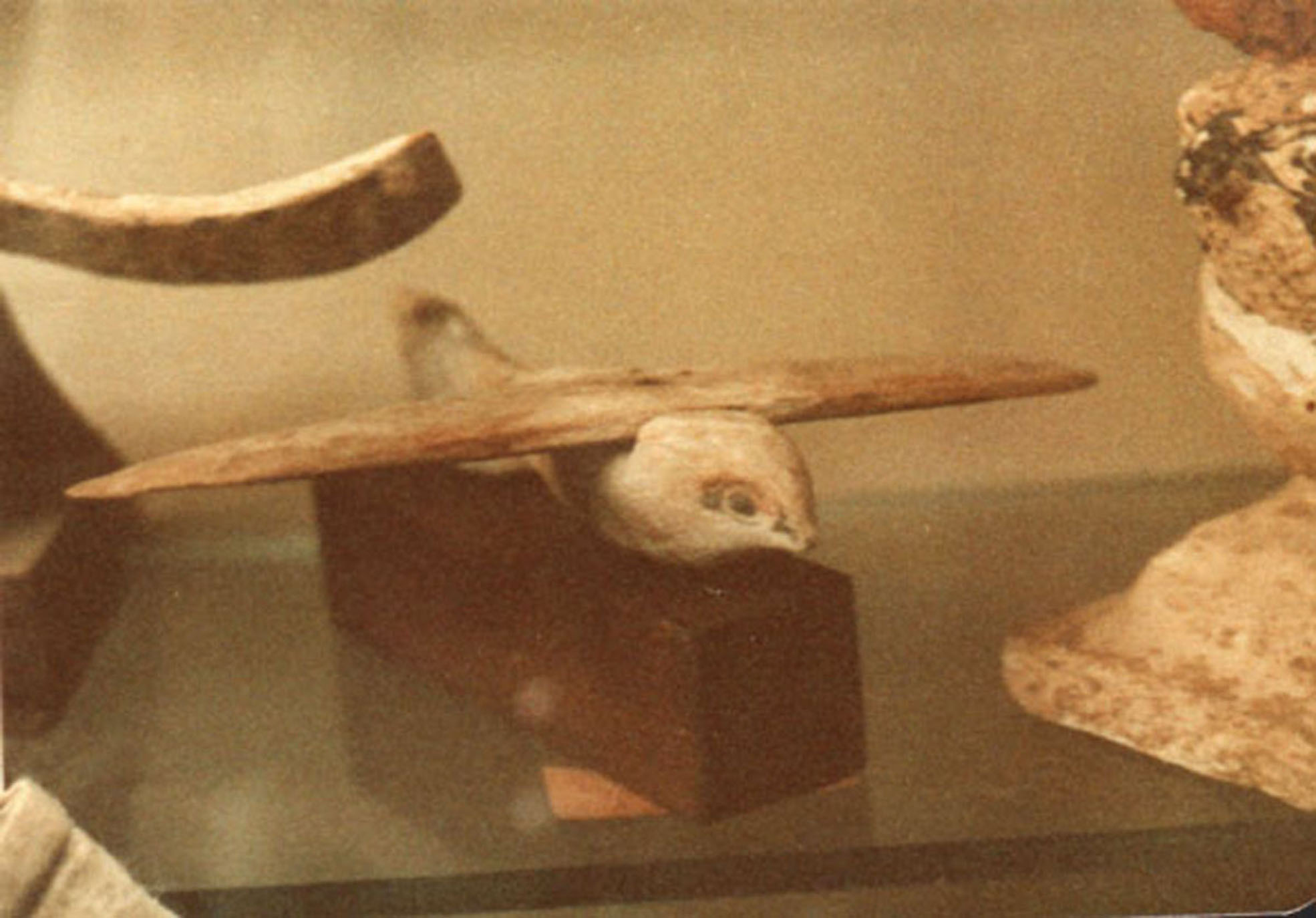
The Saqqara Bird (I got the place mixed up) is a little wooden statue of a falcon (more or less) with oddly straight wings and a flat tail with a notch in it. It already looks a lot like a toy areophane, and it files like one when thrown (if you stick another piece of wood into the slot in the tail for stabilizing, which believers think just got lost on the original. )
I've already mentioned that Araucaria chickens seem to have been in Peru before Europeans got there (which indicates possible earlier contact, probably from China). There's an engraving on a Mayan temple that looks a little like an elephant (of course, it also looks a bit like a tapir, which are local to the area, a Chinese book from around the 1500's that seems to show maize (which hadn't gotten to China, yet according to most researcher's) Egyptian mummies that have tested positive for tobacco and cocaine (though it is just as possible those were simply contaminated by the 19th century people who handled them), a Roman ship in an area of Brazil known as the Bay of Jars (due to being filled with amphorae) a roman statue head found in Mexico (possibly related to the ship, ship wrecks, head washes ashore someone picks it up, and it gets traded north. Similar to how the Maine Penny go traded down to Maine from Newfoundland where some Viking left it.) Some claims of Middle Eastern coins being found in Australia, and Roman ones in Japan (that IS verified, we know the coins are Roman we just don't know when, or how, the got to Japan. Direct contact between Rome and Japan seems unlikely.) And there is a carving on one of the walls of Angkor Wat that seems to show either a moa or a cassowary (probably the latter, since it is known they were sometimes brought from New Guinea up to Malaysia, and could have gotten to Thailand from there.
There is also some evidence that the Phoenicians may have made it to New Guinea, and that the legend of the phoenix is actually related to a trade in skins of birds of paradise. One of the brightest and commonest ones looks has two sprays of red-orange feathers under its wings, and does a hopping dance while mating, so it does look a bit like a bird dancing in flames. And the common way to prepared the skins for shipping at the time was to encase them in resin and then cover that with burned banana leaves which creates an egg shaped parcel (the Phoenix taking the ashes of it's predecessor/old body, making an egg out of them, and depositing it at the Temple of the Sun.)




 And the true story of P. vulgaris origins.


