This segregation came about in 2014. It's a nice looking seed when they well filled out but it's just not very productive where ever I happen to plant the bean. This will be the last year I will plant and grow this segregation.
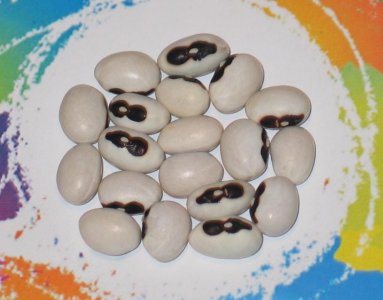
Developed from a German bean called Dwarf Blue that had inconsistent characteristics by Lisa Bloodnick of Applachia, New York. A very frequently requested bean on my website.
The first time I grew the bean I had lots of seed from it. This year I had that 10 days in early June that was cool and wet and overcast. No sun to warm the soil. I had two plantings of this bean this year and one of them never even came up. The second planting grew but not really well. All the semi runners and pole beans are going to be grown permanently out at my Bean Acres site behind the Deer fence. The soil there is lighter and lots more hours of sun every day.
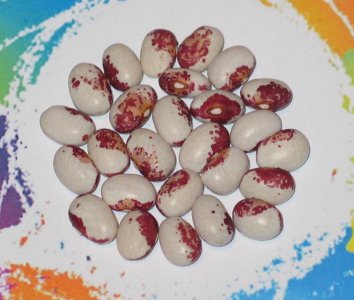
The seed shape of Rabbit's Foot 5 I suppose resembles the Giant Red Tarka but I think the color pattern is different. The Rabbit's Foot 5 has a lot more red and and not enough spotting to be a real close GRT look a like. Giant Red tarka has more of a Jacob's Cattle pattern. I could never grow an good quality GRT seed either. So I just let the network growers grow it.
I acquired this bean from Annette Barley of Nanaimo B.C. Canada in 2012. This year was the best grow out of this bean I have ever had. I had about 6 or 7 plants and they produced 14.65 ounces of beans (415.32 gm). I would consider this a large seeded bean.
Sent to me by Cordula Metzger of Labenz, Germany in 2017. It sat in a plastic container for two years before I sent it out to a grower on the west coast. Then I didn't see it back for another two years. I grew it out last year in my backyard plot with fair results and had to try it out in a different soil this year. Much better results this year. 2021 seed collected for 10 plants was 6.95 ounces (197 gm) This year I may have had two more plants but the seed harvest in 2022 was at least double, 13.70 ounces (388.38 gm).
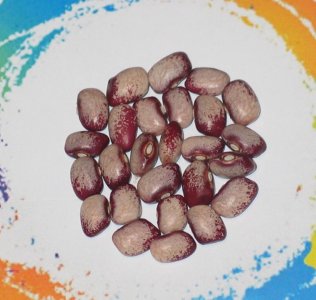
Authentic native American variety acquired in 2014. This year was my fourth grow out. It didn't produce as well this year but that is the same story with most of my pole beans. It did give me a small amount of nice quality seed. I may have had about 6 plants and they produced 8.20 ounces of seed (232.46 gm). The bean is so similar to another bean called Buxton Buckshot. That I believe they both could be related and perhaps one is just a different strain of the other. Plants, seeds, pods and blossom look exactly the same. Seneca Bird Egg is only slightly longer in it days to maturity.
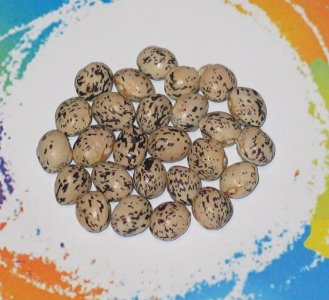
An authentic native American variety acquired in 2014. This year was my third grow out of the bean. Grown in the same plot where other pole beans were not doing so well. Seneca Cornstalk had it's best year with me so far. I may have had 6 to 8 plants that produced 14.90 ounces of beans (422.40 gm). Small seeded beans of good quality.
I wonder by the name if Seneca Cornstalk is a true cornfield bean, it that it grows and produces in the shade deep inside the corn patch rather than just in the sun on the outer rows. Ohio Pole grows like that, and they look similar except different color. In fact, Ohio Pole seems to need the shade, leaves are much smaller, and production is poor in full sun.
Ohio Pole is more bluish/purple and as far as flavor one of my favorites. Too bad it is so giant, both beans and vines, and long season, I only grow it every few years, just to keep a supply of fresh seed.
Ah, I've made it all through the bean show! Now I'm chomping at the bit to get more back to beans next year. I've grown beans every year of course but was focused a lot on some other crops last couple of seasons.
Now off to the web site to pick out about a 100 that I want and then struggle for a while trimming it down to a number that I actually have room for.





 and then struggle for a while trimming it down to a number that I actually have room for.


