"Rabbit's Foot 3.1 Several Segregations removed from the original outcross I discovered in a 4 pound package of Jacob's Cattle beans from Rancho Gordo in California. To be grown again in 2018.
"Cannellino Roso" True bush dry bean. This bean too did some what well considering all the rain at planting time. The bean comes to me from Guy Dirix in Belgium in 2016.
"Clarendon Wonder" True bush dry bean from Hal in Australia. I think he might have gotten these out of the Australian Seed Bank. I planted 5 of Hals seeds and got 5 new ones back. To be grown again in 2018.
"Gold Creek Beauty" True bush dry bean. A Robert Lobitz original bean. The photo is the entire seed crop I got for 2017 of this bean. I think this is one of those beans that looks better with age after it darkens a bit.
"Polka Dot" True Bush dry bean. Bred by Professor J.R. Hepler horticultural Professor at the University Of New Hampshire in the 1940's. Sold by his 12 year old son's seed company the Billy Hepler Seed Company in the early 1950's.
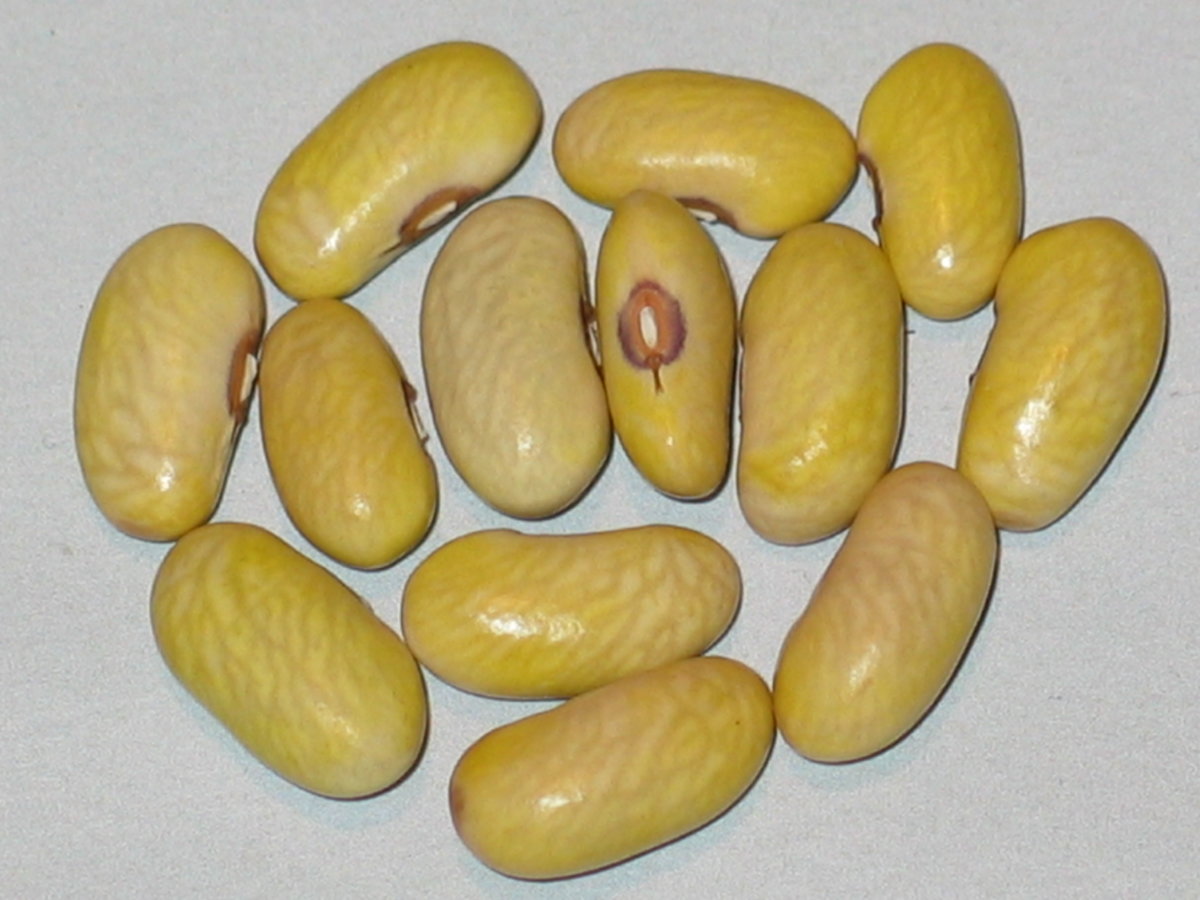
"Kishwaukee Yellow" True bush wax snap bean with good flavor. An original bean named by me in 1977 after the Kishwaukee river that flows through three northern Illinois counties. Seed mother is Cherokee Wax. I have tried and tried to select this mottled seed coat to be the representative seed coat of the bean, but it always produces a solid black seed coat and a buff tan colored one. The seed coat in the photo is the way I first discovered it. The bean was sold commercially for a time by Horus Botanicals of Salem, Arkansas back in the 1990's. I first listed the bean in the Seed Savers Exchange yearbook in 1980. The bean did some what well this season considering the heavy rain at planting time.
"Edogava Zurunacki Namame" A true bush growth habit. This bean filled out the row section I planted very well and the plants looked nearly normal in height for a bush bean. This is one I won't have to plant again next year. I acquired the bean from The Rare Vegetable Seed Consortium in 2016. I think the origin of the bean might be Georgia in eastern Europe.
"Early Warwick" A true bush dry bean. Acquired this one for a gardener in Derby, England in 2012. Normally does very well but this years seed harvest was about 1/3 of an ounce.
Hi BlueJay, I always read this thread and try very hard not to become a bean enthusiast! But I do have one question. Some of your photos say that is all the seed that you got on those beans. I know there are a lot of variables as to the low amount but it almost seems as if you only had one plant. But I'm sure this isn't the case. Why did some of your beans produce so few? Curious mind wants to know.