Solving the Squash Bug dilemma...for good!

When I use a bucket of water to collect Japanese Beetles or June Bugs I put a drop or two of dish washing liquid in it to break the surface tension so they sink better. That never hurt my chickens when they ate them.

i do that too, but figured that if the ducks are there and eating them they're not going to get away very far... :)

i did find out that JB's need to be drowned for a pretty long time to kill them. they go dormant and look dead, but they're not...
 
"Diatomaceous Earth (DE) is all natural. It’s made from tiny fossilized water plants. Because of its microscopic razor sharp edges it can be lethal to insects."

Does that idea of "razor sharp edges" on a food crop concern anyone? "Food grade?"

I have something of a "trick" stomach - used to be more so. The idea behind DE has no appeal to me.

Steve
 
I bought a 50 lb bag last fall to use this year. I have already treated my mini corn bed behind the house with it by dusting and working it in when the corn and beans were tiny. The corn is blooming. It is only 1/2 tall but , probably bc it doesn't get enough sun, but the Hubbard squash is blooming male flowers. I will monitor it there for squash bugs. This week I intend to treat 2 other beds with it. You are not supposed to use it liberally, just lightly dust.
I am fully convinced that I introduced squash bugs to my property (and squash vine borers) by purchased plants from WM.
Do you know that a local WM had viable marigolds in the "dead plants" area? The manager told me I could take them for free, and they are doing great!
 

i read through there and didn't see anything about hornets/wasps which sometimes feed on the eggs of other creatures when they are laid on leaves of plants.

i'm not sure they do it for squash bugs or not, but sometime if you ever see it happening it would be good to know. :)

isn't DE used to deworm farm animals?

we have squash bugs around and borers too. i've yet to look for them or their eggs. her scepticism about the resistant plants is warranted, but as of yet we're doing ok with just rotation planting when the bugs seem to get to be too much change the location. there are way too many rocks and other things about that i can't ever find all the bugs.
 
"Diatomaceous Earth (DE) is all natural. It’s made from tiny fossilized water plants. Because of its microscopic razor sharp edges it can be lethal to insects."

Does that idea of "razor sharp edges" on a food crop concern anyone? "Food grade?"

I have something of a "trick" stomach - used to be more so. The idea behind DE has no appeal to me.

Steve

you don't want to spray it in your face or breath the dust in, but i think it mostly will pass through if you get just a tiny amount in your gob/gullet/etc. :)
 
DE is harmful to beneficial pollinators, especially hygienic ones like honey bees. It's an indiscriminate killer, so though it's all natural and such, there are many soft bodied insects and worms you wouldn't want to come in contact with it.
 
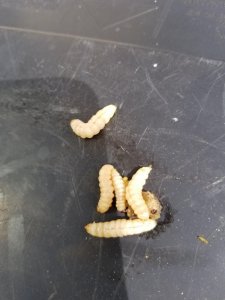
Not squash bugs but Squash Vine Borers. I did some surgery on my zucchini today and removed these plus killed several more. The most I found in any one plant was four. Most were in the main stem. Most entered fairly low but a few were up fairly far on the stem. A few even entered the leaf stalk, not the main stem. That surprised me.

Bottom line is that my zucchini is history.
Squash Vine Borers.jpg
 

Attachments

  • Squash Vine Borers.jpg
    Squash Vine Borers.jpg
    100.7 KB · Views: 383
"Diatomaceous Earth (DE) is all natural. It’s made from tiny fossilized water plants. Because of its microscopic razor sharp edges it can be lethal to insects."

Does that idea of "razor sharp edges" on a food crop concern anyone? "Food grade?"

I have something of a "trick" stomach - used to be more so. The idea behind DE has no appeal to me.

Steve
I have seen video where heavy use in a small area led to sterile soil. Plus its crap when wet so I avoid it.
 

Latest posts

Back
Top